The Ingredient List Starts with the Largest Share
Ingredient list order by weight helps you spot which ingredients lead a packaged food, compare similar products and avoid mistaking rank for an exact amount.

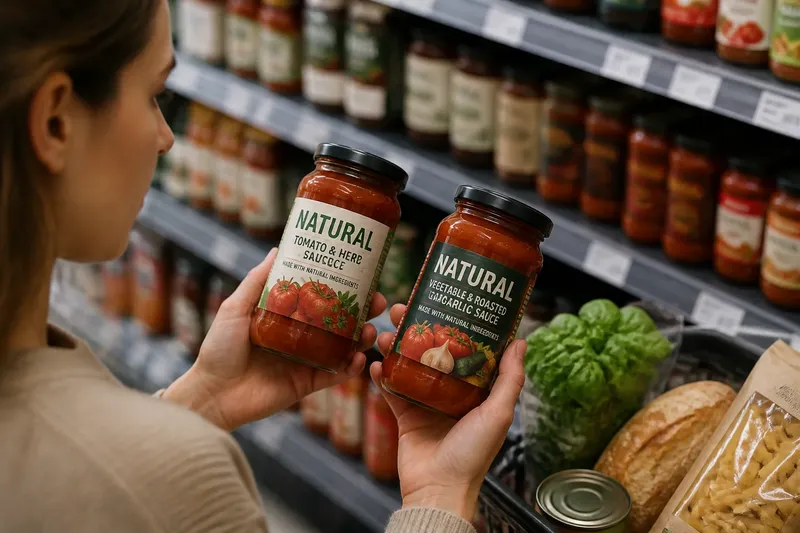
You turn over a jar of tomato sauce expecting tomatoes to lead the list, but water comes first. Ingredient list order by weight can explain the surprise: in many cases, ingredients appear from greatest to least by weight, subject to local labelling rules and exceptions.
The order is useful for asking what leads the recipe, but it is not a full recipe or a measure of quality. Read the main sequence, notice how mixtures are declared, and check the product type before drawing a conclusion.
Read the sequence for the food as sold
For many packaged foods, the first ingredient is the one present in the greatest amount by weight when the food is made. Later ingredients generally appear in descending order. Exact rules vary by jurisdiction and product, so the sequence is a guide to relative order rather than a universal calculation.
The list does not give exact proportions. It also does not tell you how much of an ingredient remains in a serving after cooking, draining or preparation. A dry soup mix and a ready-to-heat soup are different products at the point of sale, so their ingredient order may differ.
If you want to know whether a named ingredient ranks ahead of another, compare their positions. If you need its precise amount, the list alone cannot provide it; look for a separate quantity declaration where one is provided.
A pictured ingredient may not lead the recipe
A picture of strawberries or the words “with berries” can make a product seem fruit-led. Yet the list may begin with flour, sugar or oil, with fruit appearing later. Front-of-pack wording and images serve a different purpose from the ingredient sequence: the list shows ingredient order, not how prominently a component is marketed.
Find the ingredient named or pictured, then note what appears before it. Several ingredients ahead of it may indicate that it is one part of a blend rather than the leading ingredient. The order still cannot establish how much of it is present.
Say you are choosing between two oat biscuits, and the hypothetical labels list oats first in one and flour first in the other. If the products are otherwise comparable and the applicable rules make their ingredient orders comparable, that suggests oats rank higher by weight in the first biscuit. It does not reveal either recipe’s exact quantities or decide which biscuit suits you better.
Related ingredients may be listed separately
A product might contain sugar, glucose syrup and fruit concentrate instead of one ingredient called “sweetener”. Each may appear separately, so their positions do not reveal their combined amount. The same issue can arise with different flours or oils.
For a quick comparison, mark the ingredients relevant to your question, such as all the listed oils or sources of sweetness. Notice their positions, but do not add their presumed shares: rank is not enough to calculate a total. The list can show that a formulation uses several related ingredients without telling you their combined proportion.
Unfamiliar wording is not, by itself, evidence that an ingredient is present in a large amount or has a particular effect. For allergy concerns or dietary suitability, check the required allergen information and consult a qualified professional if you need advice specific to your circumstances.
Compound ingredients need careful reading
Foods can include mixtures such as chocolate chips, spice blends or prepared sauces. Depending on local labelling rules and the product, a compound ingredient may be named as a whole, followed by its components in brackets or another form. Those components should not automatically be treated as separate entries in the main sequence.
Read the main list first, then treat any bracketed components as details about the named mixture. If a sauce appears after flour in the main sequence, the sauce is positioned there as a compound ingredient; its internal components do not necessarily each occupy an independent rank in the overall list. The precise declaration rules can vary, so avoid inferring more than the label states.
One brand may spell out a mixture’s components while another uses a different permitted declaration. A longer list can reflect a difference in how the ingredients are declared, not necessarily a larger amount of them.
How should you compare ingredient order?
Why might an ingredient appear first?
In many cases, the first listed ingredient is present in the greatest amount by weight among those declared. Check the product type and local labelling rules before treating that as a firm comparison.
Does the first ingredient tell me what the food is mostly made of?
It identifies a leading ingredient by weight under the applicable ordering rules, but not its exact share. The rest of the list and the product’s form provide useful context.
Can I compare two brands?
Compare products that are genuinely similar, such as two plain oat biscuits rather than biscuits and granola bars. Different recipes, formats or declaration rules can make the order less directly comparable.
What if the ingredient I care about is near the end?
It appears after ingredients listed above it, but its exact amount cannot be read from its position. For an allergy or other health concern, rely on the relevant label information and seek qualified advice where needed.
Use the order as a clue, not a calculation
Ingredient list order by weight is most helpful when your question is modest: does the named ingredient lead, or do other ingredients come first? It can help you compare similar foods, provided you account for compound ingredients and relevant labelling rules.
It is not worth trying to reverse-engineer exact recipe shares from the sequence or rank products by list length. Compare the leading ingredients, keep the product form in view, and treat the order as a useful clue rather than a complete account of what is in the food.